
Originally featured in Fat Nugs Magazine Vol. 30: The War On Growing Methods. Enjoy the great articles and community at fatnugsmag.com.
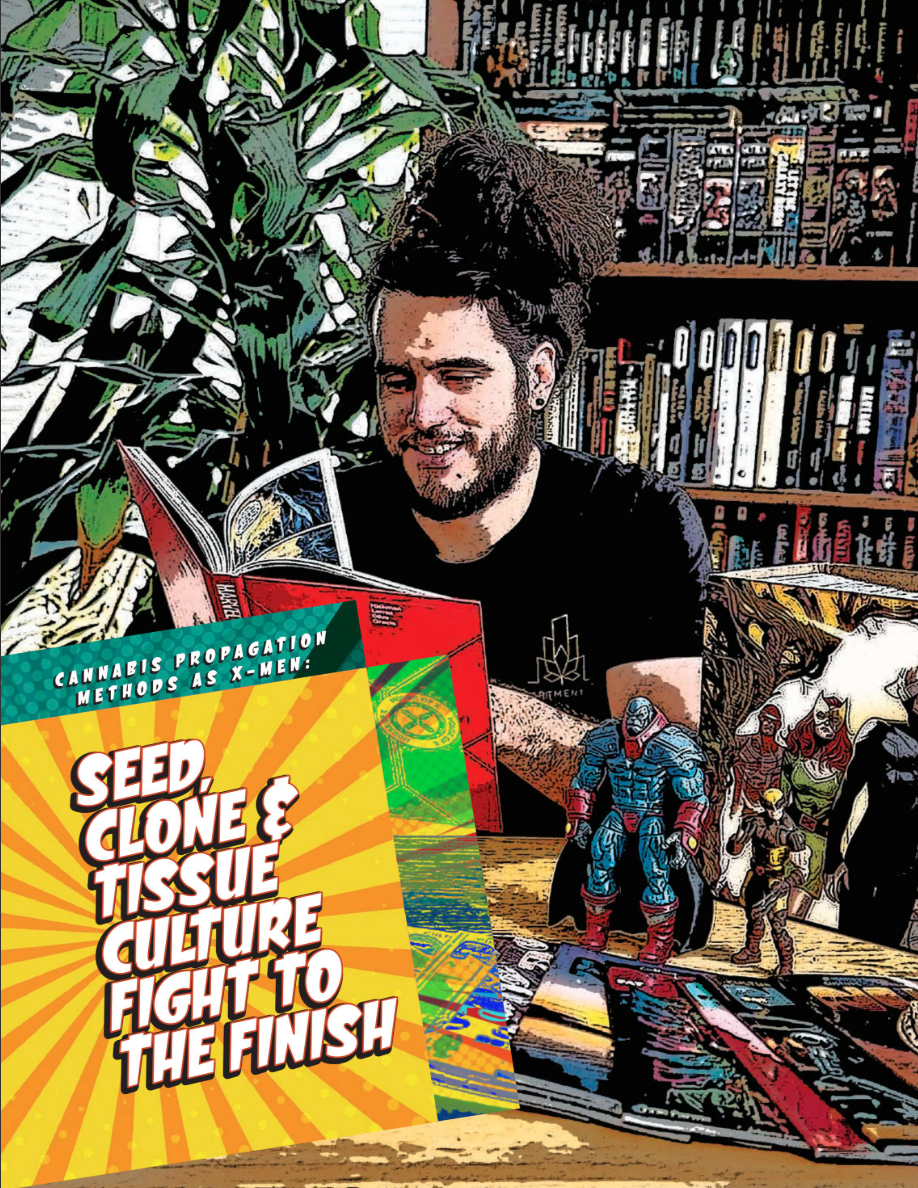
There is a Marvel character named Uatu. He's called the Watcher, and his role is to observe everything and interfere with nothing. He turns up in Marvel's What If? comics and series, where classic stories are twisted up and tested. We're taking a page out of his book today and looking at an all-out fight to the end between three propagation methods.
What if Seed, Clone, and Tissue Culture all went head to head? Who would come out on top?
Seed is the original, like X-Men's Apocalypse. It’s been on the planet for tens of millions of years and has never once been in a hurry. Clone is fast and loyal but carries something potentially dangerous. Tissue Culture does everything Clone does, but at scale. It needs a lab.
Let’s do as Uatu does and observe. Then we’ll try to do what he can’t and decide the best propagation method.
The Contenders: Seed, Clone, and Tissue Culture
Seed is the way you remember it from school. When a male flower loves a female flower very much, pollination occurs, and the resulting seed is a new individual with a genome shuffled from both parents. It isn't a continuation of either parent. It is a new genetic combination, with all the possibility and uncertainty that comes with it.
Clone is when you snip a branch off a living plant and give it some TLC before it grows roots of its own. What you get isn't a copy of the mother. It is the mother, continued. Same genetics, same traits, same potential and, unfortunately, potentially the same problems.
Tissue Culture is cloning done with a scalpel, a laminar-flow hood, and a jar of agar. You take a piece of plant so small you need magnification to trim it, then let it build hundreds of plants out of that fragment while ensuring they are healthy.
Cannabis Propagation Methods as X-Men
Seed = Apocalypse
Seeds from a cross are all different, the way siblings are. You could pop 20 of them, and there would be a similarity, but each would be unique. Some would lean toward rarer expressions. This is where a grower finds "the one," whether it be the way she smells, grows, survives, washes, smokes, or all of the above. When a keeper is found, it is time to clone.
The process is called a pheno hunt. Apocalypse, the first mutant in the X-Men, calls it survival of the fittest as he tests and culls his own. You aren't just looking for a plant that grows well. You're looking through a population for the particular combination of traits that makes one plant worth keeping.
Seed has another advantage that is easy to overlook because we usually think about propagation as what happens above the soil. A seed-grown plant starts with a taproot, a dominant root that grows downward and helps establish the plant's root system.
Seed is also patient. Cannabis split from hops roughly 28 million years ago near what is now Qinghai Lake, and every cultivar alive today traces back to one gene pool somebody in East Asia kept 12,000 years ago. Seeds kept dry and cold can hold a ~50-year half-life.
Seed was here first, and it remains the source of novelty and progress in cannabis propagation. That is Seed's advantage: it is the only method here capable of producing something genuinely new. Its weakness is that you have to grow through the uncertainty to find it.
Clone = Cable
Taking a clone is the most ordinary miracle in the room.
You find a lower branch with a couple of nodes on it. You cut at an angle with a clean blade, strip the bottom leaves so the clone isn't feeding foliage it can't support, then scrape or nick the stem. Wounded stems are ~150% more likely to root and can cut about a day and a half off rooting time. Then you dip the end in rooting hormone, set it in a plug, dome it in high humidity and gentle light, and let it ride.
For about a week, you own a branch in a cup, running on stored sugar until roots develop. Then the real advantage of Clone becomes obvious. Seed makes you search. Clone lets you stop searching. Once you've found the plant you want, you can take a cutting and make another plant with the same genetics. You don't have to wonder what the next seed will become. You already know.
To continue the X-Men associations, Clone is Cable. Apocalypse infected him as an infant with a techno-organic virus, so the Askani carried the baby 2,000 years into the future to save him and grew a clean second body from his own cells as a backup.
The pathogen cannabis clones have to worry about is Hop Latent Viroid (HLVd), which spreads fastest during propagation. An infected mother plant all but guarantees every clone off her is infected too.
Clone is fast, simple, and loyal. Find the winner once, and you can keep making winners. But if the mother isn't clean, Clones can turn one problem into a room full of problems. That's where Tissue Culture gets its chance.
Tissue Culture = The Five
Tissue Culture is the newest propagation method of the three.
You take an explant, a small piece of plant, and sterilize it. From here on, every microbe is the enemy. Then, you go smaller and take the meristem, the dome of undifferentiated cells right at the growing tip of a plant. The fragment goes onto agar with hormones tuned to make it grow shoots before the hormones are switched to cause rooting. Figure ~4 months from a piece of leaf to something you can pot, in a room where time costs real money. Contamination takes up to 50% of the starting material, usually from microbes already living inside tissue culture.
The X-Men connection here is The Five, a team of mutants on Krakoa working in sequence to resurrect X-Men. All five of them combine their powers to essentially create and age a new version of anyone who met their demise in the previous issue. Tissue Culture does something that feels similarly ridiculous the first time you see it: take a tiny piece of a plant and turn it into a population of genetically identical plants.
The solution lies in the meristem, which consists of rapidly dividing cells at the growing tip. By taking the tissue culture here, it can provide a way of separating clean growing material from systemic pathogens elsewhere in the plant. The published cure for HLVd is meristem culture with mild heat, and the heat works by pushing cell division faster than the infection can follow.
Suddenly, Tissue Culture has an answer to Clone's biggest weakness. It can take infected genetics and potentially clean them. It can also produce them at a scale neither Seed nor conventional cloning can touch. But there's a catch: it takes a lab, it takes time, and it takes skill.
Does Any of This Change the Smoke?
In 2010, a group out of Ole Miss grew the same high-THC cultivar three ways: tissue-cultured plants, conventional clones, and the mother plant herself. They compared cannabinoids across the whole arc of growth. The differences were not significant. The propagation method did not change the measured outcome.
The study, however, only measured cannabinoids. It didn't measure terpenes, and neither has anybody else in a published experiment. That's where the unanswered question lives. The plant's chemistry is more than a THC number. If the propagation method affects terpene expression, overall aroma, or other parts of the experience, we don't have the data yet to say so.
The taproot may also contribute to differences. Seed is the only one of these propagation methods that begins to develop the primary root from the start. Whether that difference is meaningful in mature plants, water access, nutrient storage, terpene production, or the overall entourage effect is the next question.
Novelty vs. Reliability
Seed creates. Tissue Culture and Clone copies. Between them, they have never produced a cultivar that didn't already exist somewhere first. That isn't a problem; it's the job description.
Every legendary cultivar started as a possibility that had to be found. Somewhere in the genetics, there was a combination that hadn't been selected before, and someone had to grow enough plants to find it. That's what the pheno hunt is really doing. It is searching the genetic lottery for the one ticket worth keeping.
Once you find it, Cloning is the way forward. Tissue Culture if you need scale. But neither one can hand you the next great plant you can get with Seed.
HLVd, The Obstacle
Hop Latent Viroid shows up and steals energy and resources from the plant, using the plant's machinery to replicate. Most of the time it doesn't present as a disease. It casually reduces your yield while the room looks fine. Tests on 15,947 Canadian samples across nine provinces came back 25.6% infected.
The viroid moves through seed too, with up to 100% infected seedlings reported from an infected seed source. Apocalypse infected Cable, remember? Seed handed this to Clone, and nobody has clean hands. Seed can spread the infection forward, but it can also create genetic variation. If resistance exists somewhere in the population, breeding is the only route here that can actually select for it and make resistance part of the plant itself.
Clone has the opposite problem. Its entire reason for existing is to preserve the mother exactly. That's fantastic for preserving desirable genetics. It is terrible when the mother is carrying a viroid.
Tissue Culture holds the only practical cleanup tool outside of breeding resistance. Meristem culture on its own cleared HLVd only ~40% of the time.
Tissue Culture can clean what you already have, but Seed can give you something that doesn't need cleaning. That is a much bigger difference than which one can produce the most.
Who Wins?
If this is a straight propagation fight, I'm giving it to Tissue Culture. If the question is, "I already have the plant I want; how do I preserve it, clean it, and make a lot more of it?" Tissue Culture wins. It has cleanliness, storage, and scale. Nothing else here is handing you thousands of genetically identical starts with the same potential for pathogen cleanup.
But consistency comes at a cost. Tissue Culture can't give you anything new. Clone can't give you anything new either. They are both exceptional at taking something worth having and making sure you keep having it. Seed is slower. Seed is messier. Seed makes you grow 20 plants when you only wanted one. It could still carry HLVd into the room. You can’t rush the growth, so the process is time-consuming.
At the same time, Seed is also the only fighter that can change the roster. It is the only one that can put resistance into the genetics instead of trying to remove the pathogen afterward and produce the plant nobody has seen yet. So on points and at scale, Tissue Culture wins. But in the fight that matters most, Seed is king. Grab some seeds today and start growing.